
Our Impact

Research Group

Quantitative Methods in Education Group

We bring together researchers to advance quantitative methods in education research, policymaking, and professional practice.

University of Southampton campus

Our impact

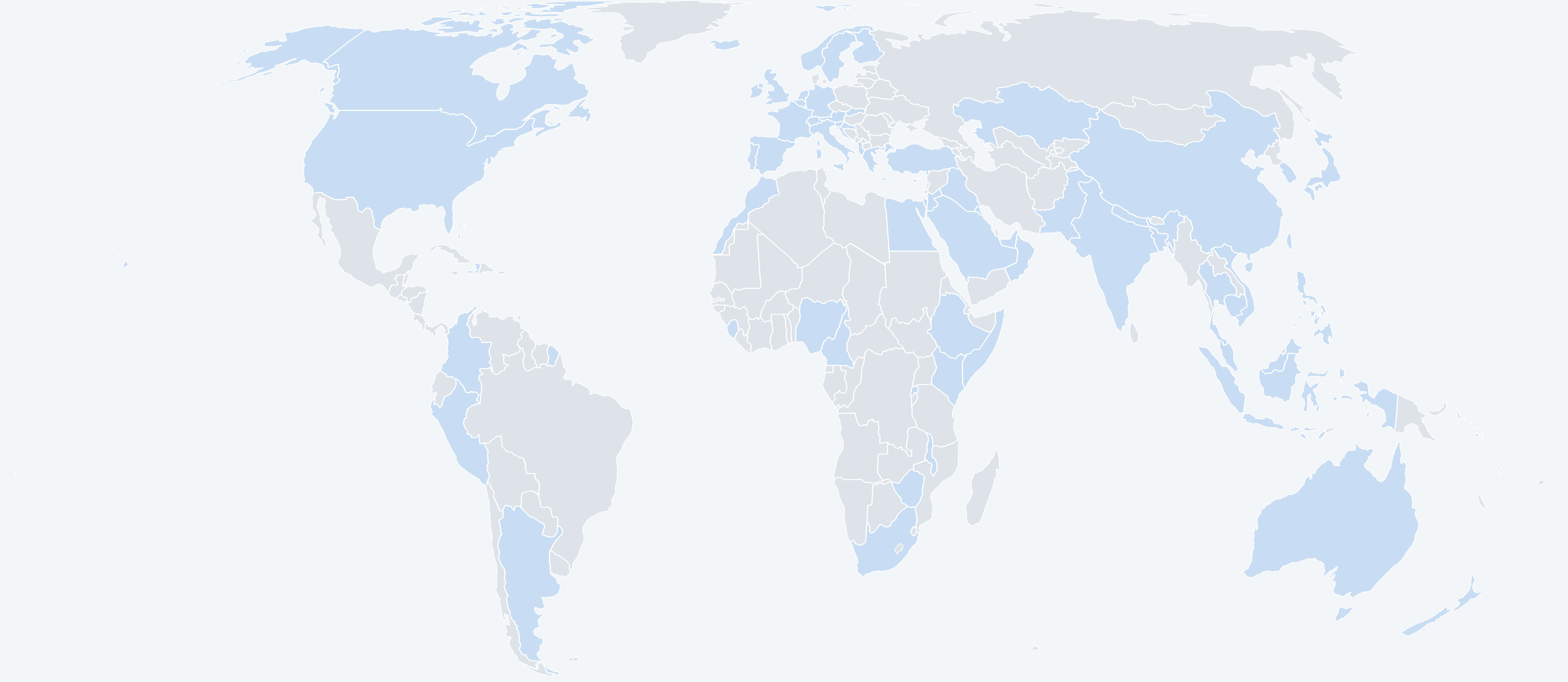
QMEG members work with researchers, policymakers and practitioners across the world. This page shows where our members, co-authors, partners and training participants are based, and how our research is used.

35

members and affiliates

at five universities in the UK, Australia and Hong Kong

126

co-author institutions

in 33 countries

619

people registered for the 2026 summer school

from 61 countries

9

disciplines

across our publications

Where our work reaches

Choose who to show and where to look, and use + and − to zoom. Select any point to see the people, publications or projects behind it.

All
Summer school participants
Co-author institutions
Members and affiliates
Project partners and funders
Summer school participantsUnited Kingdom314 people registered for the 2026 Southampton Statistics Summer School.
Members and affiliatesUniversity of Southampton30 membersAcademic staff, doctoral students and affiliates. Meet our members
Co-author institutionUniversity College London20 joint publications with QMEG members:Mind the Gap: Exploring Social Inequalities in Alcohol Consumption using Nationally Representative Data from the 2019 and 2021 Health Survey for England (2026)The inside out of journal editing and peer review: A collective reflection on the Review of Education 's mentoring scheme for early career researchers (2025)A Department-Wide Transition to a New Mode of Computer-Aided Assessment Using STACK (2024)Do schools that employ an inspector get better inspection grades? (2024)Why do women develop lower levels of political interest? Examining the influence of education, family socialisation and adult roles (2024)Testing for sequential bias in school inspections (2024)Using Social Network Analysis to gain insight into social creativity while designing digital mathematics books (2023)Are some school inspectors more lenient than others? (2023)How Useful are Ofsted Inspection judgements for Informing Secondary School Choice? (2023)A Collaboratively-Derived Research Agenda for E-assessment in Undergraduate Mathematics (2022)Students' beliefs on empirical arguments and mathematical proof in an introduction to proof class (2022)Assessing Proof Reading Comprehension Using Summaries (2021)The role of authorial context in mathematicians’ evaluations of proof (2021)Education research and educational practice: The qualities of a close relationship (2020)Demonstrating the potential of text mining for analyzing school inspection reports: a sentiment analysis of 17,000 Ofsted documents (2020)A systematic review of the evidence base for professional learning in early years education (The PLEYE Review) (2019)Socioeconomic Inequality and Student Outcomes in Italy (2019)Social inequalities in educational attainment: The changing impact of parents’ social class, social status, education and family income, England 1986 and 2010 (2019)The effects of post‐compulsory education and training systems on literacy and numeracy skills: A comparative analysis using PISA 2000 and the 2011 survey of adult skills (2018)How effective is the research and development ecosystem for England's schools? (2018)
Summer school participantsIreland39 people registered for the 2026 Southampton Statistics Summer School.
Summer school participantsChina38 people registered for the 2026 Southampton Statistics Summer School.
Co-author institutionDurham University13 joint publications with QMEG members:A Collaboratively-Derived Research Agenda for E-assessment in Undergraduate Mathematics (2022)Achieving the ‘ideas-informed’ society: results from a Structural Equation Model using survey data from England (2022)School‐to‐school collaboration in England: A configurative review of the empirical evidence (2020)Education research and educational practice: The qualities of a close relationship (2020)Facilitating collaborative reflective inquiry amongst teachers: What do we currently know? (2020)World-wide barriers and enablers to achieving evidence-informed practice in education: what can be learnt from Spain, England, the United States, and Germany? (2020)Can models of distributed leadership be used to mobilise networked generated innovation in schools? A case study from England (2020)The Covid-19 pandemic and the dissolution of the university campus: implications for student support practice (2020)Is distributed leadership an effective approach for mobilising professional capital across professional learning networks? Exploring a case from England (2020)The Networked School Leader (2020)The three roles of school leaders in maximizing the impact of Professional Learning Networks: A case study from England (2019)A systematic review of the evidence base for professional learning in early years education (The PLEYE Review) (2019)Using theories of action approach to measure impact in an intelligent way: A case study from Ontario Canada (2019)
Co-author institutionEducation University of Hong Kong13 joint publications with QMEG members:Pursuing social justice through education policy programmes: capturing subtleties with a modified welfare regime analysis (2026)The use and impact of digital interventions on mental health and wellbeing of forced migrants: A systematic review of empirical studies (2025)Straight from the teacher's mouth: The value of own-perspective gaze-elicited think-aloud for understanding culture-specific teacher expertise (2025)Impacts of school context and formal teaching on entrepreneurial attributes: a social learning perspective (2025)Failing interventions to harness English fever infiltrating early childhood education in South Korea: politics of distraction (2024)The ‘everywhere and nowhere’ English language policy in Queensland government schools: a license for commercialisation (2022)Decolonisation of curriculum: the case of language education policy in Nepal (2022)English fever: educational policies in globalised Korea, 1981–2018 (2021)Discourses shaping the language-in-education policy and foreign language education in Nepal: an intersectional perspective (2021)Policymakers’ agency and the structure: the case of medium of instruction policy in multilingual Nepal (2020)Language-in-education Policy Formation through a Consultation-based System: The Case of Multilingual Curricula in Cambodian Universities (2020)Outsourcing education services in South Korea, England and Hong Kong: a discursive institutionalist analysis (2019)A heuristic model for tailoring teacher development to educational reforms: Focusing on ambiguity and conflict generation (2018)
Summer school participantsUnited States34 people registered for the 2026 Southampton Statistics Summer School.
Co-author institutionUniversity of Oxford11 joint publications with QMEG members:The role of media in PISA 2022 mathematics education policymaking in Anglophone countries (2026)The inside out of journal editing and peer review: A collective reflection on the Review of Education 's mentoring scheme for early career researchers (2025)Selection effects in education and implications for educational opportunity: state of the field and future directions (2024)Challenges facing interventions to promote equity in the early years: exploring the ‘impact’, legacy and lessons learned from a national evaluation of Children’s Centres in England (2022)Investigating the reliability and validity of the Toddler Home Learning Environment (THLE) scale (2021)Negative capital: a generalised definition and application to educational effectiveness and equity (2020)Airbag moderation: the definition and statistical implementation of a new methodological model (2020)The contribution of Multilevel Structural Equation Modelling to contemporary trends in educational research (2020)Relationships between families’ use of Sure Start Children’s Centres, changes in home learning environments, and preschool behavioural disorders (2019)Investigating a Singapore-Based Mathematics Textbook and Teaching Approach in Classrooms in England (2019)Exposure to violence, teacher support, and school delay amongst adolescents in South Africa (2018)
Co-author institutionUniversity of Portsmouth8 joint publications with QMEG members:Bounded decision‐making, teachers’ reflection and organisational learning: How research can inform teachers and teaching (2019)Exploring the current context for Professional Learning Networks, the conditions for their success, and research needs moving forwards (2019)Exploring the impact of social relationships on teachers’ use of research: A regression analysis of 389 teachers in England (2018)Lost in translation? Can the use of theories of action be effective in helping teachers develop and scale up research-informed practices? (2018)Networks for learning: Effective collaboration for teacher, school and system improvement (2018)Going for Broke: A Multiple-Case Study of Brokerage in Education (2018)How effective is the research and development ecosystem for England's schools? (2018)Does a theory of action approach help teachers engage in evidence-informed self-improvement? (2018)
Members and affiliatesThe University of Newcastle2 membersProfessor Elena Prieto-RodriguezDr Zara Ersozlu
Summer school participantsGermany19 people registered for the 2026 Southampton Statistics Summer School.
Summer school participantsIndia17 people registered for the 2026 Southampton Statistics Summer School.
Co-author institutionUniversity of Groningen6 joint publications with QMEG members:Longitudinal social network methods for the educational and psychological sciences (2025)Constructing theoretically informed measures of pause duration in experimentally manipulated writing (2022)The development of communication networks of pre-service teachers on a school-led and university-led programme of initial teacher education in England (2020)Aligning Keystrokes with Cognitive Processes in Writing (2019)The Work of Writing: Raiding the Inarticulate (2018)Discovery Through Writing: Relationships with Writing Processes and Text Quality (2018)
Co-author institutionMonash University6 joint publications with QMEG members:Capturing and sharing know-how through visual process representations: a human-Centred approach to teacher workflows (2026)How Do Critical Evaluations of Generative AI Outputs Shape Teacher Agency? A Mixed-Methods Comparative Analysis (2026)Co-Creating a Community-Focused Educational Knowledge Graph for Trustworthy Language Knowledge: A Case Study on Yanyuwa (2026)Scalable LLM-based Coding of Dialogue in Healthcare Simulation: Balancing Coding Performance, Processing Time, and Environmental Impact (2026)Trace Data of Secondary Students and Linguistic Analysis to Predict Learner Performance in a Multi‐Text Writing Task (2026)Self-Regulated Learning in Essay Writing: Consistency of Strategies and Impact on Outcomes (2026)
Summer school participantsHong Kong14 people registered for the 2026 Southampton Statistics Summer School.
Summer school participantsSingapore13 people registered for the 2026 Southampton Statistics Summer School.
Members and affiliatesBournemouth University1 memberDr Natalia Lavrushkina
Members and affiliatesThe University of Hong Kong1 memberProfessor Dragan Gašević
Members and affiliatesMonash University1 memberDr Gloria Fernandez-Nieto
Co-author institutionLoughborough University5 joint publications with QMEG members:Comparative judgement in education research (2023)Comparative judgement for experimental philosophy: A method for assessing ordinary meaning in vehicles in the park cases (2023)A Collaboratively-Derived Research Agenda for E-assessment in Undergraduate Mathematics (2022)Assessing Proof Reading Comprehension Using Summaries (2021)Comparative judgement, proof summaries and proof comprehension (2020)
Co-author institutionWest Virginia University4 joint publications with QMEG members:Students' beliefs on empirical arguments and mathematical proof in an introduction to proof class (2022)The role of authorial context in mathematicians’ evaluations of proof (2021)Comparative judgement, proof summaries and proof comprehension (2020)What do mathematicians mean by proof? A comparative-judgement study of students’ and mathematicians’ views (2020)
Co-author institutionUniversity of Nottingham4 joint publications with QMEG members:The role of media in PISA 2022 mathematics education policymaking in Anglophone countries (2026)Reciprocal relationships between adolescent mental health difficulties and alcohol consumption (2025)Do informal networks become formalised over time? Analysing school networks and multi-academy trust membership in England using ego-centric analysis (2023)Storytelling With Networks: Realizing the Explanatory Potential of Network Diagrams Through the Integration of Qualitative Data (2023)
Co-author institutionMedizinische Hochschule Hannover4 joint publications with QMEG members:Are all risks equal? Understanding the differential mechanism linking early environmental risk and obesity via the interplay of mental health and lifestyle factors (2026)Mind the Gap: Exploring Social Inequalities in Alcohol Consumption using Nationally Representative Data from the 2019 and 2021 Health Survey for England (2026)Reciprocal relationships between adolescent mental health difficulties and alcohol consumption (2025)Adolescent delinquency following co-occurring childhood head injuries and conduct problem symptoms: findings from a UK longitudinal birth cohort (2023)
Co-author institutionUniversity of Warwick4 joint publications with QMEG members:The inside out of journal editing and peer review: A collective reflection on the Review of Education 's mentoring scheme for early career researchers (2025)Do pupils at research-informed schools actually perform better? Findings from a study at English schools (2023)Exploring effective approaches for stimulating ideas-engagement amongst adults in England: results from a randomised control trial (2022)Airbag moderation: the definition and statistical implementation of a new methodological model (2020)
Co-author institutionUniversity of Sussex4 joint publications with QMEG members:Country and school family composition’s effects on mathematics achievement (2022)Challenges facing interventions to promote equity in the early years: exploring the ‘impact’, legacy and lessons learned from a national evaluation of Children’s Centres in England (2022)Investigating the reliability and validity of the Toddler Home Learning Environment (THLE) scale (2021)Relationships between families’ use of Sure Start Children’s Centres, changes in home learning environments, and preschool behavioural disorders (2019)
Summer school participantsItaly9 people registered for the 2026 Southampton Statistics Summer School.
Summer school participantsJapan9 people registered for the 2026 Southampton Statistics Summer School.
Summer school participantsMalaysia9 people registered for the 2026 Southampton Statistics Summer School.
Co-author institutionUniversity of Cambridge3 joint publications with QMEG members:Technology Use for Teacher Professional Development in Low- and Middle-Income Countries: A systematic review (2022)Looking to relate: teacher gaze and culture in student-rated teacher interpersonal behaviour (2020)Bounded decision‐making, teachers’ reflection and organisational learning: How research can inform teachers and teaching (2019)
Co-author institutionUniversity of Glasgow3 joint publications with QMEG members:Do informal networks become formalised over time? Analysing school networks and multi-academy trust membership in England using ego-centric analysis (2023)Storytelling With Networks: Realizing the Explanatory Potential of Network Diagrams Through the Integration of Qualitative Data (2023)School‐to‐school collaboration in England: A configurative review of the empirical evidence (2020)
Co-author institutionUniversity of Edinburgh3 joint publications with QMEG members:Student approaches to generating mathematical examples: comparing e-assessment and paper-based tasks (2024)Comparative judgement for experimental philosophy: A method for assessing ordinary meaning in vehicles in the park cases (2023)A Collaboratively-Derived Research Agenda for E-assessment in Undergraduate Mathematics (2022)
Co-author institutionUniversity of Amsterdam3 joint publications with QMEG members:A Collaboratively-Derived Research Agenda for E-assessment in Undergraduate Mathematics (2022)METHODOLOGICAL ADVANCES IN INVESTIGATING L2 WRITING PROCESSES (2019)Teaching Digital Methods: Interview with Richard Rogers. Interviewer: S. Lewthwaite (2019)
Co-author institutionUniversity of Macau3 joint publications with QMEG members:Capturing and sharing know-how through visual process representations: a human-Centred approach to teacher workflows (2026)How Do Critical Evaluations of Generative AI Outputs Shape Teacher Agency? A Mixed-Methods Comparative Analysis (2026)Co-Creating a Community-Focused Educational Knowledge Graph for Trustworthy Language Knowledge: A Case Study on Yanyuwa (2026)
Summer school participantsPakistan6 people registered for the 2026 Southampton Statistics Summer School.
Summer school participantsTürkiye6 people registered for the 2026 Southampton Statistics Summer School.
Summer school participantsFrance6 people registered for the 2026 Southampton Statistics Summer School.
Project partners and fundersESRC and UKRIFunders of QMEG projects on digital research skills, research methods capacity and learning inequalities.
Project partners and fundersNuffield Foundation, Ambition Institute and British CouncilFunders and partners for research on school inspection, school leadership and English language teaching.
Project partners and fundersOxford University PressPartner in a randomised controlled trial of a reading programme.
Project partners and fundersDevon Partnership NHS TrustPartner in an NIHR-funded project on parenting and financial wellbeing support.
Project partners and fundersBritish Council projectSupporting English language teachers to adopt multilingual teaching.
Project partners and fundersEARLI Centre of ExcellenceInternational centre for research on teacher professional vision.
Summer school participantsJordan4 people registered for the 2026 Southampton Statistics Summer School.
Summer school participantsNigeria4 people registered for the 2026 Southampton Statistics Summer School.
Summer school participantsCanada4 people registered for the 2026 Southampton Statistics Summer School.
Summer school participantsSweden4 people registered for the 2026 Southampton Statistics Summer School.
Summer school participantsNetherlands4 people registered for the 2026 Southampton Statistics Summer School.
Summer school participantsPortugal4 people registered for the 2026 Southampton Statistics Summer School.
Co-author institutionUniversity of Manchester2 joint publications with QMEG members:School‐to‐school collaboration in England: A configurative review of the empirical evidence (2020)Is distributed leadership an effective approach for mobilising professional capital across professional learning networks? Exploring a case from England (2020)
Co-author institutionUniversity of Sheffield2 joint publications with QMEG members:Scanpath analysis of expertise and culture in teacher gaze in real-world classrooms (2018)Reactivity effects in video-based classroom research: an investigation using teacher and student questionnaires as well as teacher eye-tracking (2017)
Co-author institutionUniversity of Plymouth2 joint publications with QMEG members:How are parenting programmes implemented in practice? A mixed-methods study in England (2026)Facilitating collaborative reflective inquiry amongst teachers: What do we currently know? (2020)
Co-author institutionUtrecht University2 joint publications with QMEG members:Handling Demanding Situations: Associations between Teachers’ Interpersonal Behavior, Physiological Responses, and Emotions (2023)Looking to relate: teacher gaze and culture in student-rated teacher interpersonal behaviour (2020)
Co-author institutionInstitut d'Etudes Politiques de Paris2 joint publications with QMEG members:Parental Schooling, Educational Attainment, Skills, and Earnings: A Trend Analysis across Fifteen Countries (2023)Socioeconomic Inequality and Student Outcomes in Italy (2019)
Co-author institutionUniversity of East Anglia2 joint publications with QMEG members:The inside out of journal editing and peer review: A collective reflection on the Review of Education 's mentoring scheme for early career researchers (2025)Outsourcing education services in South Korea, England and Hong Kong: a discursive institutionalist analysis (2019)
Co-author institutionUniversity of London2 joint publications with QMEG members:The inside out of journal editing and peer review: A collective reflection on the Review of Education 's mentoring scheme for early career researchers (2025)Accessibility in Austerity: Formulating Strategies for Accessibility Research in Constrained Times (2025)
Co-author institutionMiami University2 joint publications with QMEG members:World-wide barriers and enablers to achieving evidence-informed practice in education: what can be learnt from Spain, England, the United States, and Germany? (2020)Going for Broke: A Multiple-Case Study of Brokerage in Education (2018)
Co-author institutionQueen's University2 joint publications with QMEG members:Can models of distributed leadership be used to mobilise networked generated innovation in schools? A case study from England (2020)Is distributed leadership an effective approach for mobilising professional capital across professional learning networks? Exploring a case from England (2020)
Co-author institutionTribhuvan University2 joint publications with QMEG members:Migrant Population’s Linguistic Identities in Motion: A New Mobilities Perspective (2026)Enactment of English medium instruction in under-resourced educational contexts: A case of multilingual public secondary schools in Nepal (2024)
Co-author institutionUniversity of Exeter2 joint publications with QMEG members:How are parenting programmes implemented in practice? A mixed-methods study in England (2026)Negative capital: a generalised definition and application to educational effectiveness and equity (2020)
Co-author institutionNational Centre for Research Methods2 joint publications with QMEG members:Student perspectives on learning research methods in the social sciences (2019)Methods that teach: developing pedagogic research methods, developing pedagogy (2018)
Co-author institutionPädagogische Hochschule Vorarlberg2 joint publications with QMEG members:Achieving the ‘ideas-informed’ society: results from a Structural Equation Model using survey data from England (2022)Exploring effective approaches for stimulating ideas-engagement amongst adults in England: results from a randomised control trial (2022)
Co-author institutionJiangxi Normal University2 joint publications with QMEG members:Master Mathematics Teachers (2023)Rational numbers and proportional reasoning in Chinese primary schools: Patterns, latent classes, and reasoning processes (2022)
Co-author institutionRMIT University2 joint publications with QMEG members:Capturing and sharing know-how through visual process representations: a human-Centred approach to teacher workflows (2026)Scalable LLM-based Coding of Dialogue in Healthcare Simulation: Balancing Coding Performance, Processing Time, and Environmental Impact (2026)
Co-author institutionUniversity of Hong Kong2 joint publications with QMEG members:Scalable LLM-based Coding of Dialogue in Healthcare Simulation: Balancing Coding Performance, Processing Time, and Environmental Impact (2026)Trace Data of Secondary Students and Linguistic Analysis to Predict Learner Performance in a Multi‐Text Writing Task (2026)
Summer school participantsIndonesia3 people registered for the 2026 Southampton Statistics Summer School.
Summer school participantsSouth Korea3 people registered for the 2026 Southampton Statistics Summer School.
Summer school participantsTaiwan3 people registered for the 2026 Southampton Statistics Summer School.
Summer school participantsVietnam3 people registered for the 2026 Southampton Statistics Summer School.
Summer school participantsAlbania2 people registered for the 2026 Southampton Statistics Summer School.
Summer school participantsSouth Africa2 people registered for the 2026 Southampton Statistics Summer School.
Summer school participantsKuwait2 people registered for the 2026 Southampton Statistics Summer School.
Summer school participantsSwitzerland2 people registered for the 2026 Southampton Statistics Summer School.
Summer school participantsColombia2 people registered for the 2026 Southampton Statistics Summer School.
Summer school participantsEgypt2 people registered for the 2026 Southampton Statistics Summer School.
Summer school participantsBangladesh2 people registered for the 2026 Southampton Statistics Summer School.
Summer school participantsBelgium2 people registered for the 2026 Southampton Statistics Summer School.
Summer school participantsFinland2 people registered for the 2026 Southampton Statistics Summer School.
Summer school participantsAustralia2 people registered for the 2026 Southampton Statistics Summer School.
Summer school participantsSomalia2 people registered for the 2026 Southampton Statistics Summer School.
Summer school participantsMorocco2 people registered for the 2026 Southampton Statistics Summer School.
Co-author institutionOverseas Development Institute1 joint publication with QMEG members:Technology Use for Teacher Professional Development in Low- and Middle-Income Countries: A systematic review (2022)
Co-author institutionEdge Hill University1 joint publication with QMEG members:Bounded decision‐making, teachers’ reflection and organisational learning: How research can inform teachers and teaching (2019)
Co-author institutionUniversity of Essex1 joint publication with QMEG members:Scanpath analysis of expertise and culture in teacher gaze in real-world classrooms (2018)
Co-author institutionDIPF | Leibniz Institute for Research and Information in Education1 joint publication with QMEG members:Reactivity effects in video-based classroom research: an investigation using teacher and student questionnaires as well as teacher eye-tracking (2017)
Co-author institutionUniversity of York1 joint publication with QMEG members:Reactivity effects in video-based classroom research: an investigation using teacher and student questionnaires as well as teacher eye-tracking (2017)
Co-author institutionUniversity of Twente1 joint publication with QMEG members:Facilitating collaborative reflective inquiry amongst teachers: What do we currently know? (2020)
Co-author institutionUniversity of Tübingen1 joint publication with QMEG members:Facilitating collaborative reflective inquiry amongst teachers: What do we currently know? (2020)
Co-author institutionSaudi Electronic University1 joint publication with QMEG members:A Collaboratively-Derived Research Agenda for E-assessment in Undergraduate Mathematics (2022)
Co-author institutionUniversity of the West of England1 joint publication with QMEG members:A Collaboratively-Derived Research Agenda for E-assessment in Undergraduate Mathematics (2022)
Co-author institutionThe Open University1 joint publication with QMEG members:A Collaboratively-Derived Research Agenda for E-assessment in Undergraduate Mathematics (2022)
Co-author institutionUniversity of Auckland1 joint publication with QMEG members:A Collaboratively-Derived Research Agenda for E-assessment in Undergraduate Mathematics (2022)
Co-author institutionUniversity of Agder1 joint publication with QMEG members:A Collaboratively-Derived Research Agenda for E-assessment in Undergraduate Mathematics (2022)
Co-author institutionUniversity of Birmingham1 joint publication with QMEG members:A Collaboratively-Derived Research Agenda for E-assessment in Undergraduate Mathematics (2022)
Co-author institutionNational University of Ireland, Maynooth1 joint publication with QMEG members:A Collaboratively-Derived Research Agenda for E-assessment in Undergraduate Mathematics (2022)
Co-author institutionSheffield Hallam University1 joint publication with QMEG members:A Collaboratively-Derived Research Agenda for E-assessment in Undergraduate Mathematics (2022)
Co-author institutionHeriot-Watt University1 joint publication with QMEG members:A Collaboratively-Derived Research Agenda for E-assessment in Undergraduate Mathematics (2022)
Co-author institutionSapienza University of Rome1 joint publication with QMEG members:Socioeconomic Inequality and Student Outcomes in Italy (2019)
Co-author institutionBirkbeck, University of London1 joint publication with QMEG members:Exploring the impact of social relationships on teachers’ use of research: A regression analysis of 389 teachers in England (2018)
Co-author institutionNational Taipei University of Education1 joint publication with QMEG members:Efficacy, explore, and exchange: Studies on social side of teacher education from England, Spain, and US (2019)
Co-author institutionUniversity of California San Diego1 joint publication with QMEG members:Efficacy, explore, and exchange: Studies on social side of teacher education from England, Spain, and US (2019)
Co-author institutionUniversitat Ramon Llull1 joint publication with QMEG members:Efficacy, explore, and exchange: Studies on social side of teacher education from England, Spain, and US (2019)
Co-author institutionSolent NHS Trust1 joint publication with QMEG members:Reciprocal relationships between adolescent mental health difficulties and alcohol consumption (2025)
Co-author institutionNYU Langone Health1 joint publication with QMEG members:Reciprocal relationships between adolescent mental health difficulties and alcohol consumption (2025)
Co-author institutionUniversity of Bari Aldo Moro1 joint publication with QMEG members:Reciprocal relationships between adolescent mental health difficulties and alcohol consumption (2025)
Co-author institutionNew York University1 joint publication with QMEG members:Reciprocal relationships between adolescent mental health difficulties and alcohol consumption (2025)
Co-author institutionVictoria University of Wellington1 joint publication with QMEG members:The bidirectional relationship between head injuries and conduct problems: longitudinal modelling of a population-based birth cohort study (2023)
Co-author institutionMaxwell Institute for Mathematical Sciences1 joint publication with QMEG members:Student approaches to generating mathematical examples: comparing e-assessment and paper-based tasks (2024)
Co-author institutionUniversity of St Andrews1 joint publication with QMEG members:The inside out of journal editing and peer review: A collective reflection on the Review of Education 's mentoring scheme for early career researchers (2025)
Co-author institutionHalmstad University1 joint publication with QMEG members:The inside out of journal editing and peer review: A collective reflection on the Review of Education 's mentoring scheme for early career researchers (2025)
Co-author institutionUniversity of Wolverhampton1 joint publication with QMEG members:The inside out of journal editing and peer review: A collective reflection on the Review of Education 's mentoring scheme for early career researchers (2025)
Co-author institutionAston University1 joint publication with QMEG members:The inside out of journal editing and peer review: A collective reflection on the Review of Education 's mentoring scheme for early career researchers (2025)
Co-author institutionUniversity of Leeds1 joint publication with QMEG members:The inside out of journal editing and peer review: A collective reflection on the Review of Education 's mentoring scheme for early career researchers (2025)
Co-author institutionNanjing University of Science and Technology1 joint publication with QMEG members:The inside out of journal editing and peer review: A collective reflection on the Review of Education 's mentoring scheme for early career researchers (2025)
Co-author institutionGoldsmiths University of London1 joint publication with QMEG members:The inside out of journal editing and peer review: A collective reflection on the Review of Education 's mentoring scheme for early career researchers (2025)
Co-author institutionUniversitat Autònoma de Barcelona1 joint publication with QMEG members:World-wide barriers and enablers to achieving evidence-informed practice in education: what can be learnt from Spain, England, the United States, and Germany? (2020)
Co-author institutionUniversity of Duisburg-Essen1 joint publication with QMEG members:World-wide barriers and enablers to achieving evidence-informed practice in education: what can be learnt from Spain, England, the United States, and Germany? (2020)
Co-author institutionZurich University of Teacher Education1 joint publication with QMEG members:World-wide barriers and enablers to achieving evidence-informed practice in education: what can be learnt from Spain, England, the United States, and Germany? (2020)
Co-author institutionThe University of Queensland1 joint publication with QMEG members:The ‘everywhere and nowhere’ English language policy in Queensland government schools: a license for commercialisation (2022)
Co-author institutionQueensland University of Technology1 joint publication with QMEG members:The ‘everywhere and nowhere’ English language policy in Queensland government schools: a license for commercialisation (2022)
Co-author institutionAustralian Catholic University1 joint publication with QMEG members:The ‘everywhere and nowhere’ English language policy in Queensland government schools: a license for commercialisation (2022)
Co-author institutionZhejiang University1 joint publication with QMEG members:How do students'roles in collaborative learning affect collaborative problem-solving competency? A systematic review of research (2023)
Co-author institutionUniversity of Iceland1 joint publication with QMEG members:Keeping track of expert teachers: Comparing the affordances of think-aloud elicited by two different video perspectives (2021)
Co-author institutionCheongju National University of Education1 joint publication with QMEG members:Outsourcing education services in South Korea, England and Hong Kong: a discursive institutionalist analysis (2019)
Co-author institutionNational University of Singapore1 joint publication with QMEG members:Does public consultation affect policy formulation? Negotiation strategies between the administration and citizens (2023)
Co-author institutionNational and Kapodistrian University of Athens1 joint publication with QMEG members:Using Social Network Analysis to gain insight into social creativity while designing digital mathematics books (2023)
Co-author institutionLeiden University1 joint publication with QMEG members:Handling Demanding Situations: Associations between Teachers’ Interpersonal Behavior, Physiological Responses, and Emotions (2023)
Co-author institutionHang Seng University of Hong Kong1 joint publication with QMEG members:Impacts of school context and formal teaching on entrepreneurial attributes: a social learning perspective (2025)
Co-author institutionInternational Hellenic University1 joint publication with QMEG members:Challenges facing interventions to promote equity in the early years: exploring the ‘impact’, legacy and lessons learned from a national evaluation of Children’s Centres in England (2022)
Co-author institutionCapital Normal University1 joint publication with QMEG members:Pursuing social justice through education policy programmes: capturing subtleties with a modified welfare regime analysis (2026)
Co-author institutionBeijing Normal University1 joint publication with QMEG members:Pursuing social justice through education policy programmes: capturing subtleties with a modified welfare regime analysis (2026)
Co-author institution21st Century Education Research Institute1 joint publication with QMEG members:Understanding the progress in mathematics of Chinese adolescents: Significant impacts from the socioeconomic status and the academic expectations of primary caregivers (2019)
Co-author institutionUniversity of Leicester1 joint publication with QMEG members:Student perspectives on learning research methods in the social sciences (2019)
Co-author institutionUniversity of Bristol1 joint publication with QMEG members:Student perspectives on learning research methods in the social sciences (2019)
Co-author institutionCentre National de la Recherche Scientifique1 joint publication with QMEG members:Parental Schooling, Educational Attainment, Skills, and Earnings: A Trend Analysis across Fifteen Countries (2023)
Co-author institutionCentre de recherche sur les Inégalités Sociales1 joint publication with QMEG members:Parental Schooling, Educational Attainment, Skills, and Earnings: A Trend Analysis across Fifteen Countries (2023)
Co-author institutionKorea National University of Education1 joint publication with QMEG members:The influence of the Programme for International Student Assessment on educational governance situated in the institutional setting of South Korea (2023)
Co-author institutionShanghai Jiao Tong University1 joint publication with QMEG members:Secondary school students' learning persistence in human‐ AI hybrid learning: The supplementary role of parental mediation (2025)
Co-author institutionUniversity of California, Riverside1 joint publication with QMEG members:Selection effects in education and implications for educational opportunity: state of the field and future directions (2024)
Co-author institutionUniversity of Cape Town1 joint publication with QMEG members:Exposure to violence, teacher support, and school delay amongst adolescents in South Africa (2018)
Co-author institutionLeuphana University of Lüneburg1 joint publication with QMEG members:ICT knowledge absorptive capacity: A critical factor for technology integration in schools (2025)
Co-author institutionIU International University of Applied Sciences1 joint publication with QMEG members:ICT knowledge absorptive capacity: A critical factor for technology integration in schools (2025)
Co-author institutionEge University1 joint publication with QMEG members:ICT knowledge absorptive capacity: A critical factor for technology integration in schools (2025)
Co-author institutionUniversity of Calgary1 joint publication with QMEG members:ICT knowledge absorptive capacity: A critical factor for technology integration in schools (2025)
Co-author institutionTechnische Universität Berlin1 joint publication with QMEG members:Comparative judgement for experimental philosophy: A method for assessing ordinary meaning in vehicles in the park cases (2023)
Co-author institutionUniversity of Battambang1 joint publication with QMEG members:Language-in-education Policy Formation through a Consultation-based System: The Case of Multilingual Curricula in Cambodian Universities (2020)
Co-author institutionJohannes Kepler University of Linz1 joint publication with QMEG members:Do pupils at research-informed schools actually perform better? Findings from a study at English schools (2023)
Co-author institutionUniversity of Helsinki1 joint publication with QMEG members:Students in sight: Using mobile eye-tracking to investigate mathematics teachers’ gaze behaviour during task instruction-giving (2021)
Co-author institutionEmerald Group Publishing (United Kingdom)1 joint publication with QMEG members:Achieving the ‘ideas-informed’ society: results from a Structural Equation Model using survey data from England (2022)
Co-author institutionZhejiang Normal University1 joint publication with QMEG members:English-medium instruction as an internationalisation strategy at a second-tier Chinese University: instructors’ challenges and their shaping factors (2024)
Co-author institutionXingzhi College Zhejiang Normal University1 joint publication with QMEG members:English-medium instruction as an internationalisation strategy at a second-tier Chinese University: instructors’ challenges and their shaping factors (2024)
Co-author institutionRustaq College of Education1 joint publication with QMEG members:Does revision process differ across language of writing (L1 vs. FL), FL language proficiency and gender? (2021)
Co-author institutionVrije Universiteit Brussel1 joint publication with QMEG members:Measuring Reflective Inquiry in Professional Learning Networks: A Conceptual Framework (2025)
Co-author institutionHasselt University1 joint publication with QMEG members:Measuring Reflective Inquiry in Professional Learning Networks: A Conceptual Framework (2025)
Co-author institutionHangzhou Normal University1 joint publication with QMEG members:Rational numbers and proportional reasoning in Chinese primary schools: Patterns, latent classes, and reasoning processes (2022)
Co-author institutionUniversity of Cyprus1 joint publication with QMEG members:Rational numbers and proportional reasoning in Chinese primary schools: Patterns, latent classes, and reasoning processes (2022)
Co-author institutionWestern Washington University1 joint publication with QMEG members:Editorial: Advancing digital accessibility in academic and workplace education (2024)
Co-author institutionStuttgart Media University1 joint publication with QMEG members:Editorial: Advancing digital accessibility in academic and workplace education (2024)
Co-author institutionSwansea University1 joint publication with QMEG members:Master Mathematics Teachers (2023)
Co-author institutionKing's College London1 joint publication with QMEG members:Accessibility in Austerity: Formulating Strategies for Accessibility Research in Constrained Times (2025)
Co-author institutionBirmingham City University1 joint publication with QMEG members:Accessibility in Austerity: Formulating Strategies for Accessibility Research in Constrained Times (2025)
Co-author institutionSt George's, University of London1 joint publication with QMEG members:Accessibility in Austerity: Formulating Strategies for Accessibility Research in Constrained Times (2025)
Co-author institutionCity St George's, University of London1 joint publication with QMEG members:Accessibility in Austerity: Formulating Strategies for Accessibility Research in Constrained Times (2025)
Co-author institutionYork University1 joint publication with QMEG members:Accessibility in Austerity: Formulating Strategies for Accessibility Research in Constrained Times (2025)
Co-author institutionCardiff University1 joint publication with QMEG members:Accessibility in Austerity: Formulating Strategies for Accessibility Research in Constrained Times (2025)
Co-author institutionInstitute of Alcohol Studies1 joint publication with QMEG members:Mind the Gap: Exploring Social Inequalities in Alcohol Consumption using Nationally Representative Data from the 2019 and 2021 Health Survey for England (2026)
Co-author institutionHong Kong Polytechnic University1 joint publication with QMEG members:How Do Critical Evaluations of Generative AI Outputs Shape Teacher Agency? A Mixed-Methods Comparative Analysis (2026)
Co-author institutionUniversity of South Africa1 joint publication with QMEG members:Co-Creating a Community-Focused Educational Knowledge Graph for Trustworthy Language Knowledge: A Case Study on Yanyuwa (2026)
Co-author institutionThe University of Adelaide1 joint publication with QMEG members:Scalable LLM-based Coding of Dialogue in Healthcare Simulation: Balancing Coding Performance, Processing Time, and Environmental Impact (2026)
Co-author institutionEscuela Superior Politecnica del Litoral1 joint publication with QMEG members:Scalable LLM-based Coding of Dialogue in Healthcare Simulation: Balancing Coding Performance, Processing Time, and Environmental Impact (2026)
Co-author institutionUmm al-Qura University1 joint publication with QMEG members:Trace Data of Secondary Students and Linguistic Analysis to Predict Learner Performance in a Multi‐Text Writing Task (2026)
Co-author institutionUniversity of Oulu1 joint publication with QMEG members:Trace Data of Secondary Students and Linguistic Analysis to Predict Learner Performance in a Multi‐Text Writing Task (2026)
Co-author institutionTechnical University of Munich1 joint publication with QMEG members:Trace Data of Secondary Students and Linguistic Analysis to Predict Learner Performance in a Multi‐Text Writing Task (2026)
Summer school participantsGreece1 person registered for the 2026 Southampton Statistics Summer School.
Summer school participantsMalawi1 person registered for the 2026 Southampton Statistics Summer School.
Summer school participantsUnited Arab Emirates1 person registered for the 2026 Southampton Statistics Summer School.
Summer school participantsArgentina1 person registered for the 2026 Southampton Statistics Summer School.
Summer school participantsIraq1 person registered for the 2026 Southampton Statistics Summer School.
Summer school participantsSpain1 person registered for the 2026 Southampton Statistics Summer School.
Summer school participantsNew Zealand1 person registered for the 2026 Southampton Statistics Summer School.
Summer school participantsCroatia1 person registered for the 2026 Southampton Statistics Summer School.
Summer school participantsThailand1 person registered for the 2026 Southampton Statistics Summer School.
Summer school participantsZimbabwe1 person registered for the 2026 Southampton Statistics Summer School.
Summer school participantsSierra Leone1 person registered for the 2026 Southampton Statistics Summer School.
Summer school participantsLuxembourg1 person registered for the 2026 Southampton Statistics Summer School.
Summer school participantsRwanda1 person registered for the 2026 Southampton Statistics Summer School.
Summer school participantsNepal1 person registered for the 2026 Southampton Statistics Summer School.
Summer school participantsCameroon1 person registered for the 2026 Southampton Statistics Summer School.
Summer school participantsPhilippines1 person registered for the 2026 Southampton Statistics Summer School.
Summer school participantsSlovakia1 person registered for the 2026 Southampton Statistics Summer School.
Summer school participantsHaiti1 person registered for the 2026 Southampton Statistics Summer School.
Summer school participantsPeru1 person registered for the 2026 Southampton Statistics Summer School.
Summer school participantsSlovenia1 person registered for the 2026 Southampton Statistics Summer School.
Summer school participantsKenya1 person registered for the 2026 Southampton Statistics Summer School.
Summer school participantsEthiopia1 person registered for the 2026 Southampton Statistics Summer School.
Summer school participantsKazakhstan1 person registered for the 2026 Southampton Statistics Summer School.
Summer school participantsIsrael1 person registered for the 2026 Southampton Statistics Summer School.
Summer school participantsRéunion1 person registered for the 2026 Southampton Statistics Summer School.
World
UK and Ireland
Europe
Americas
Africa and Middle East
Asia and Pacific
Zoom inZoom out
Zoom inZoom out
Zoom inZoom out
Point sizemore people or publications

Across sectors

Our research is funded by, carried out with and used by organisations well beyond universities.

Government and public bodies

Commissioned research and responses to government consultations.

Health

Partners and co-authors on research into families, mental health and wellbeing.
Research funders

Funders of QMEG research projects.
Charities and foundations

Funders and partners for research on inspection, school leadership and language teaching.

Research institutes and networks

Collaborators on research methods, education and policy research.
Industry and publishing

Partners in programme evaluation and research publishing.

Across disciplines

Our members are based in education, statistics, psychology, health and management. Our publications and training reach well beyond education research.

Our publications by discipline

Select a block to see the publications in it.

Education73%Publications by disciplineEducation118 publications, 73% of the total:Using technology for questioning evidence in pre-service teacher education (2026)Novice Principals as Multi-level Change Agents: Readiness to Lead (2026)Pursuing social justice through education policy programmes: capturing subtleties with a modified welfare regime analysis (2026)Cross-cultural differential item functioning in the PISA 2022 creative thinking assessment (2026)Being Human (2026)The role of media in PISA 2022 mathematics education policymaking in Anglophone countries (2026)Parents as ‘data bridges’: Platformisation and emerging educational inequities in early childhood education and care (2026)Towards a unified understanding of educational equity: Integrating narratives of access and outcome (2026)16-19 Level 1 English and Maths Qualifications – Government consultation (2026)Co-Creating a Community-Focused Educational Knowledge Graph for Trustworthy Language Knowledge: A Case Study on Yanyuwa (2026)Scalable LLM-based Coding of Dialogue in Healthcare Simulation: Balancing Coding Performance, Processing Time, and Environmental Impact (2026)Trace Data of Secondary Students and Linguistic Analysis to Predict Learner Performance in a Multi‐Text Writing Task (2026)Self-Regulated Learning in Essay Writing: Consistency of Strategies and Impact on Outcomes (2026)The inside out of journal editing and peer review: A collective reflection on the Review of Education 's mentoring scheme for early career researchers (2025)Examining how generative AI tools benefit and challenge teachers’ research-informed practice (2025)Adult–child pedagogical interactions in the home and in preschool: what commonalities can pre-schoolers experience in the context of cognitive development? (2025)Straight from the teacher's mouth: The value of own-perspective gaze-elicited think-aloud for understanding culture-specific teacher expertise (2025)Impacts of school context and formal teaching on entrepreneurial attributes: a social learning perspective (2025)Building digital cube houses to improve mental rotation skills (2025)Tackling misinformation: where do educationalists need to target their efforts? (2025)Secondary school students' learning persistence in human‐ AI hybrid learning: The supplementary role of parental mediation (2025)ICT knowledge absorptive capacity: A critical factor for technology integration in schools (2025)Education, prospection and social networks: surveying ideas-engagement amongst 7,000 respondents across seven European countries (2025)Measuring Reflective Inquiry in Professional Learning Networks: A Conceptual Framework (2025)A Department-Wide Transition to a New Mode of Computer-Aided Assessment Using STACK (2024)Student approaches to generating mathematical examples: comparing e-assessment and paper-based tasks (2024)Outsourcing of Teaching English to Speakers of Other Languages (2024)Do schools that employ an inspector get better inspection grades? (2024)Representativeness and diversity within the teaching profession in England, 2010–2020 (2024)Testing for sequential bias in school inspections (2024)Selection effects in education and implications for educational opportunity: state of the field and future directions (2024)Do informal networks become formalised over time? Analysing school networks and multi-academy trust membership in England using ego-centric analysis (2023)How do students'roles in collaborative learning affect collaborative problem-solving competency? A systematic review of research (2023)Does public consultation affect policy formulation? Negotiation strategies between the administration and citizens (2023)Using Social Network Analysis to gain insight into social creativity while designing digital mathematics books (2023)Handling Demanding Situations: Associations between Teachers’ Interpersonal Behavior, Physiological Responses, and Emotions (2023)Comparative judgement in education research (2023)Are some school inspectors more lenient than others? (2023)How Useful are Ofsted Inspection judgements for Informing Secondary School Choice? (2023)The influence of the Programme for International Student Assessment on educational governance situated in the institutional setting of South Korea (2023)Using EDA measures to detect emotional expressions during family science activities, a methodological perspective (2023)Do pupils at research-informed schools actually perform better? Findings from a study at English schools (2023)Master Mathematics Teachers (2023)The Impact of Support Networks on the Education and Development of Pre-Service Teachers (2023)Technology Use for Teacher Professional Development in Low- and Middle-Income Countries: A systematic review (2022)A Collaboratively-Derived Research Agenda for E-assessment in Undergraduate Mathematics (2022)Access to online learning: Machine learning analysis from a social justice perspective (2022)Constructing theoretically informed measures of pause duration in experimentally manipulated writing (2022)Accelerating online learning: Machine learning insights into the importance of cumulative experience, independence, and country setting (2022)The ‘everywhere and nowhere’ English language policy in Queensland government schools: a license for commercialisation (2022)The influence of school climate and achievement on bullying: Comparative evidence from international large-scale assessment data (2022)Country and school family composition’s effects on mathematics achievement (2022)The end of the line? A quantitative analysis of two decades of competitive assessment and research funding in UK higher education (2022)Challenges facing interventions to promote equity in the early years: exploring the ‘impact’, legacy and lessons learned from a national evaluation of Children’s Centres in England (2022)Students' beliefs on empirical arguments and mathematical proof in an introduction to proof class (2022)The role of analytical variability in secondary data replications: a replication of Kim et al. (2014) (2022)Decolonisation of curriculum: the case of language education policy in Nepal (2022)The Routledge International Handbook of Research on Writing (2022)Achieving the ‘ideas-informed’ society: results from a Structural Equation Model using survey data from England (2022)Are instructional practices different between East and West? An analysis of Grade 8 TIMSS 2019 data (2022)Exploring effective approaches for stimulating ideas-engagement amongst adults in England: results from a randomised control trial (2022)Rational numbers and proportional reasoning in Chinese primary schools: Patterns, latent classes, and reasoning processes (2022)A tale of two algorithms: The appeal and repeal of calculated grades systems in England and Ireland in 2020 (2021)Assessing Proof Reading Comprehension Using Summaries (2021)Targeting data collection in games based assessment (2021)English fever: educational policies in globalised Korea, 1981–2018 (2021)Keeping track of expert teachers: Comparing the affordances of think-aloud elicited by two different video perspectives (2021)The role of authorial context in mathematicians’ evaluations of proof (2021)Students in sight: Using mobile eye-tracking to investigate mathematics teachers’ gaze behaviour during task instruction-giving (2021)Learning inequalities during the Covid-19 pandemic. A longitudinal analysis using the UK Understanding Society 2020 and 2021 data (2021)Investigating the reliability and validity of the Toddler Home Learning Environment (THLE) scale (2021)School‐to‐school collaboration in England: A configurative review of the empirical evidence (2020)Education research and educational practice: The qualities of a close relationship (2020)Facilitating collaborative reflective inquiry amongst teachers: What do we currently know? (2020)International Perspectives in Educational Effectiveness Research (2020)Comparative judgement, proof summaries and proof comprehension (2020)The development of communication networks of pre-service teachers on a school-led and university-led programme of initial teacher education in England (2020)World-wide barriers and enablers to achieving evidence-informed practice in education: what can be learnt from Spain, England, the United States, and Germany? (2020)Can models of distributed leadership be used to mobilise networked generated innovation in schools? A case study from England (2020)What do mathematicians mean by proof? A comparative-judgement study of students’ and mathematicians’ views (2020)Negative capital: a generalised definition and application to educational effectiveness and equity (2020)The Covid-19 pandemic and the dissolution of the university campus: implications for student support practice (2020)Demonstrating the potential of text mining for analyzing school inspection reports: a sentiment analysis of 17,000 Ofsted documents (2020)Promoting pre-service teachers' engagement in an online professional learning community (2020)Is distributed leadership an effective approach for mobilising professional capital across professional learning networks? Exploring a case from England (2020)The Networked School Leader (2020)Airbag moderation: the definition and statistical implementation of a new methodological model (2020)The contribution of Multilevel Structural Equation Modelling to contemporary trends in educational research (2020)Bounded decision‐making, teachers’ reflection and organisational learning: How research can inform teachers and teaching (2019)The three roles of school leaders in maximizing the impact of Professional Learning Networks: A case study from England (2019)A systematic review of the evidence base for professional learning in early years education (The PLEYE Review) (2019)Socioeconomic Inequality and Student Outcomes in Italy (2019)Efficacy, explore, and exchange: Studies on social side of teacher education from England, Spain, and US (2019)Using theories of action approach to measure impact in an intelligent way: A case study from Ontario Canada (2019)A conceptual-empirical typology of social science research methods pedagogy (2019)Outsourcing education services in South Korea, England and Hong Kong: a discursive institutionalist analysis (2019)Relationships between families’ use of Sure Start Children’s Centres, changes in home learning environments, and preschool behavioural disorders (2019)Understanding the progress in mathematics of Chinese adolescents: Significant impacts from the socioeconomic status and the academic expectations of primary caregivers (2019)Aligning Keystrokes with Cognitive Processes in Writing (2019)Student perspectives on learning research methods in the social sciences (2019)Investigating a Singapore-Based Mathematics Textbook and Teaching Approach in Classrooms in England (2019)Exploring the current context for Professional Learning Networks, the conditions for their success, and research needs moving forwards (2019)School/University Partnerships: An English Perspective (2019)Scanpath analysis of expertise and culture in teacher gaze in real-world classrooms (2018)Exploring the impact of social relationships on teachers’ use of research: A regression analysis of 389 teachers in England (2018)A new composite measure of ethnic diversity: Investigating the controversy over minority ethnic recruitment at Oxford and Cambridge universities (2018)Lost in translation? Can the use of theories of action be effective in helping teachers develop and scale up research-informed practices? (2018)A heuristic model for tailoring teacher development to educational reforms: Focusing on ambiguity and conflict generation (2018)Towards a philosophy of equity in educational effectiveness research: moving from utilitarianism to a Rawlsian paradigm (2018)Mapping changes in support: a longitudinal analysis of networks of pre-service mathematics and science teachers (2018)Methods that teach: developing pedagogic research methods, developing pedagogy (2018)The effects of post‐compulsory education and training systems on literacy and numeracy skills: A comparative analysis using PISA 2000 and the 2011 survey of adult skills (2018)Networks for learning: Effective collaboration for teacher, school and system improvement (2018)Going for Broke: A Multiple-Case Study of Brokerage in Education (2018)How effective is the research and development ecosystem for England's schools? (2018)Does a theory of action approach help teachers engage in evidence-informed self-improvement? (2018)Utilising social network analysis to identify the structural features of teachers’ knowledge and resource-sharing networks within schools (2018)Reactivity effects in video-based classroom research: an investigation using teacher and student questionnaires as well as teacher eye-tracking (2017)
Languages, linguistics and humanities7%Publications by disciplineLanguages, linguistics and humanities11 publications, 7% of the total:Migrant Population’s Linguistic Identities in Motion: A New Mobilities Perspective (2026)Enactment of English medium instruction in under-resourced educational contexts: A case of multilingual public secondary schools in Nepal (2024)Failing interventions to harness English fever infiltrating early childhood education in South Korea: politics of distraction (2024)English-medium instruction as an internationalisation strategy at a second-tier Chinese University: instructors’ challenges and their shaping factors (2024)Comparative judgement for experimental philosophy: A method for assessing ordinary meaning in vehicles in the park cases (2023)Discourses shaping the language-in-education policy and foreign language education in Nepal: an intersectional perspective (2021)Does revision process differ across language of writing (L1 vs. FL), FL language proficiency and gender? (2021)Policymakers’ agency and the structure: the case of medium of instruction policy in multilingual Nepal (2020)Language-in-education Policy Formation through a Consultation-based System: The Case of Multilingual Curricula in Cambodian Universities (2020)METHODOLOGICAL ADVANCES IN INVESTIGATING L2 WRITING PROCESSES (2019)Teaching Digital Methods: Interview with Richard Rogers. Interviewer: S. Lewthwaite (2019)
Mathematics, computing and engineering6%Publications by disciplineMathematics, computing and engineering10 publications, 6% of the total:Capturing and sharing know-how through visual process representations: a human-Centred approach to teacher workflows (2026)How Do Critical Evaluations of Generative AI Outputs Shape Teacher Agency? A Mixed-Methods Comparative Analysis (2026)Making Better Decisions, Eschewing Conspiracy, Populism, and Science Denial: Analysing the Attributes of Individuals Who Engage Effectively with Ideas (2025)Accessibility in Austerity: Formulating Strategies for Accessibility Research in Constrained Times (2025)Is There Cognitive Engagement When They Comment ‘Haha’: A Dynamic Analysis of Cognitive and Emotional Engagement in Game Video Comments (2024)Digital Accessibility Education in Context: Expert Perspectives on Building Capacity in Academia and the Workplace (2024)An agent-based model of school tracking, accountability, and segregation (2024)Editorial: Advancing digital accessibility in academic and workplace education (2024)Workplace approaches to teaching digital accessibility: establishing a common foundation of awareness and understanding (2023)Researching Pedagogy in Digital Accessibility Education (2022)
Psychology6%Publications by disciplinePsychology9 publications, 6% of the total:Are all risks equal? Understanding the differential mechanism linking early environmental risk and obesity via the interplay of mental health and lifestyle factors (2026)The use and impact of digital interventions on mental health and wellbeing of forced migrants: A systematic review of empirical studies (2025)Reciprocal relationships between adolescent mental health difficulties and alcohol consumption (2025)The bidirectional relationship between head injuries and conduct problems: longitudinal modelling of a population-based birth cohort study (2023)Adolescent delinquency following co-occurring childhood head injuries and conduct problem symptoms: findings from a UK longitudinal birth cohort (2023)Looking to relate: teacher gaze and culture in student-rated teacher interpersonal behaviour (2020)The Work of Writing: Raiding the Inarticulate (2018)Discovery Through Writing: Relationships with Writing Processes and Text Quality (2018)Exposure to violence, teacher support, and school delay amongst adolescents in South Africa (2018)
Sociology and social policy6%Publications by disciplineSociology and social policy9 publications, 6% of the total:Longitudinal social network methods for the educational and psychological sciences (2025)Socio-economic differences in remote schoolwork during the COVID-19 pandemic: a trend analysis of the 2020 and 2021 school-closure periods using the UK Understanding Society data (2024)Parental Schooling, Educational Attainment, Skills, and Earnings: A Trend Analysis across Fifteen Countries (2023)Storytelling With Networks: Realizing the Explanatory Potential of Network Diagrams Through the Integration of Qualitative Data (2023)Accessible at last?: what do new European digital accessibility laws mean for disabled people in the UK? (2020)To leave or not to leave? Understanding the support for the United Kingdom membership in the European Union: Identity, attitudes towards the political system and socio-economic status (2020)Teaching Accessibility in Computer Science and Related Disciplines (2020)Social inequalities in educational attainment: The changing impact of parents’ social class, social status, education and family income, England 1986 and 2010 (2019)Automated generation of ‘good enough’ transcripts as a first step to transcription of audio-recorded data (2018)
Health and life sciences1%Publications by disciplineHealth and life sciences2 publications, 1% of the total:Mind the Gap: Exploring Social Inequalities in Alcohol Consumption using Nationally Representative Data from the 2019 and 2021 Health Survey for England (2026)How are parenting programmes implemented in practice? A mixed-methods study in England (2026)
Geography, environment and development1%Publications by disciplineGeography, environment and development1 publication, 1% of the total:International postgraduate students' labour mobility in the United Kingdom: A cross‐classified multilevel analysis (2020)
Politics and international studies1%Publications by disciplinePolitics and international studies1 publication, 1% of the total:Why do women develop lower levels of political interest? Examining the influence of education, family socialisation and adult roles (2024)
Economics1%Publications by disciplineEconomics1 publication, 1% of the total:The effect of computerisation on the wage share in United Kingdom workplaces (2021)
  • Education73%
  • Languages, linguistics and humanities7%
  • Mathematics, computing and engineering6%
  • Psychology6%
  • Sociology and social policy6%
  • Health and life sciences1%
  • Geography, environment and development1%
  • Politics and international studies1%
  • Economics1%
Who comes to our summer school

Participants by discipline, 2026.

  • Psychology16%
  • Mathematics, computing and engineering15%
  • Business and management12%
  • Education12%
  • Languages, linguistics and humanities8%
  • Economics8%
  • Sociology and social policy7%
  • Health and life sciences7%
  • Politics and international studies4%
  • Geography, environment and development4%
  • Physical and natural sciences3%
  • Law and criminology2%
  • Other2%

Both charts group disciplines using the REF 2021 units of assessment, with closely related units combined.